Choosing the right undergraduate degree is an important decision for students planning their higher education and future careers. In India, undergraduate education has undergone significant changes following the introduction of the National Education Policy (NEP) 2020. One important development is the availability of different undergraduate degree structures, including three-year and four-year programs.
Traditionally, most undergraduate courses in India, such as Bachelor of Arts (BA), Bachelor of Commerce (BCom), and Bachelor of Science (BSc), were completed in three years. However, the four-year undergraduate structure introduced under the NEP 2020 provides additional opportunities for advanced learning, research, skill development, and multidisciplinary education.
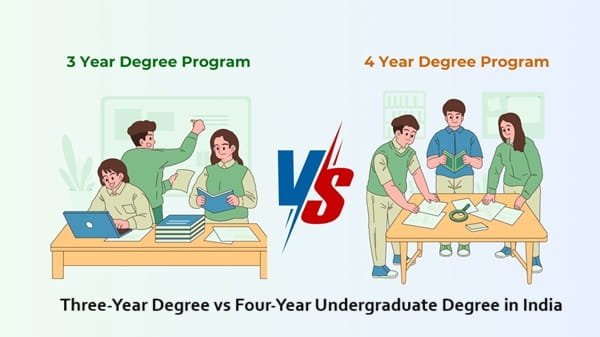
Both degree structures have their own advantages, eligibility requirements, academic expectations, and career opportunities. While a three-year degree allows students to complete graduation in less time, a four-year undergraduate degree may provide additional academic exposure and research opportunities. Understanding their differences can help students select a program that matches their career goals, financial situation, and higher education plans.
What Is a Three-Year Undergraduate Degree?
A three-year undergraduate degree is a traditional graduation program in which students complete their education over six semesters, generally spread across three academic years.
Popular three-year undergraduate programs in India include:
- Bachelor of Arts (BA).
- Bachelor of Commerce (BCom).
- Bachelor of Science (BSc).
- Bachelor of Business Administration (BBA), where offered.
- Bachelor of Computer Applications (BCA), where offered.
These programs generally focus on developing subject knowledge, foundational academic skills, and professional understanding.
For example, a three-year BCom program covers subjects such as accounting, economics, business law, taxation, and financial management. Similarly, a BA program provides opportunities to study humanities, social sciences, languages, and other subjects.
A three-year degree is suitable for students who want to complete their graduation within a shorter period and move towards employment, competitive examinations, or postgraduate education.
What Is a Four-Year Undergraduate Degree?
A four-year undergraduate degree is a higher education program that generally takes eight semesters to complete.
Under the National Education Policy 2020 and the UGC’s Curriculum and Credit Framework for Undergraduate Programmes, universities can offer flexible undergraduate structures with multiple entry and exit options.
Depending on the university’s approved framework, students may receive different qualifications based on the credits and academic requirements completed.
The four-year structure generally provides opportunities for:
- Advanced subject learning.
- Multidisciplinary education.
- Research projects and dissertations.
- Internships and practical training.
- Skill-based and vocational courses.
- Greater academic specialization.
Students completing the prescribed requirements of a four-year honours or honours with research program may receive a corresponding degree qualification.
However, the availability of these options depends on the university, course, and applicable academic regulations.
Three-Year Degree vs Four-Year Undergraduate Degree: Key Differences
| Comparison Factor | Three-Year Degree | Four-Year Degree |
| Duration | 3 years | 4 years |
| Total semesters | Generally 6 | Generally 8 |
| Academic structure | Traditional undergraduate curriculum | Flexible, multidisciplinary curriculum |
| Research opportunities | Depend on the course and university | Additional research opportunities may be available |
| Specialization | Subject-focused learning | Opportunities for advanced specialization |
| Internships | Depend on the university | May include additional internship opportunities |
| Graduation timeline | Earlier completion | Requires one additional year |
| Financial expenses | Generally lower | Generally higher |
| Higher education | Eligible for master’s programs subject to requirements | May offer additional academic pathways |
Differences in Curriculum and Learning Opportunities
The curriculum is an important factor that distinguishes three-year and four-year undergraduate programs.
Three-Year Degree Curriculum
A three-year degree generally focuses on core subjects and foundational knowledge in the selected discipline. Students complete compulsory subjects, electives, practical assignments, and examinations according to the university’s academic structure.
For example, a three-year BSc program may focus on subjects such as Physics, Chemistry, Mathematics, or Computer Science, depending on the student’s chosen specialization.
Four-Year Undergraduate Curriculum
A four-year program provides additional time for advanced learning, multidisciplinary subjects, research, internships, and specialized study.
Students may have opportunities to select minor subjects, explore different academic disciplines, and complete projects related to their major subject.
Under the UGC framework, the four-year structure may also include an Honours with Research option, subject to eligibility and university requirements.
Verdict: A three-year degree provides a focused undergraduate education, while a four-year program offers additional opportunities for advanced learning and academic specialization.
Higher Education Opportunities After Graduation
The duration of an undergraduate degree can influence the postgraduate education options available to students.
Under the UGC’s 2025 minimum standards framework, students completing a three-year undergraduate degree can generally pursue a two-year postgraduate program. Students completing a four-year undergraduate degree with Honours or Honours with Research can be eligible for a one-year postgraduate program, subject to university admission requirements.
A four-year Honours with Research degree may also provide a stronger foundation for students interested in research-oriented postgraduate education and doctoral studies.
However, students should remember that postgraduate admission depends on entrance examinations, subject requirements, minimum marks, and the eligibility criteria of the selected university.
Fees and Overall Education Expenses
The financial difference between these programs is another important consideration.
A three-year degree generally involves lower overall education expenses because students complete their undergraduate studies one year earlier. This can help reduce tuition fees, accommodation costs, transportation expenses, and other academic charges.
A four-year degree requires an additional year of study, which may increase the total financial investment. However, additional research opportunities, internships, and specialized courses may provide valuable academic and professional benefits.
Students should compare the complete course fee structure and available scholarships before choosing either program.
Advantages and Disadvantages of Three-Year and Four-Year Degrees
Advantages of Three-Year Degrees
- Students complete graduation in a shorter period.
- Generally involve lower overall education expenses.
- Allow students to enter the workforce earlier.
- Provide eligibility for postgraduate programs.
- Suitable for students who prefer focused subject-based learning.
Disadvantages of Three-Year Degrees
- Less time for advanced specialization.
- May offer fewer opportunities for extended research.
- Limited additional time for internships and interdisciplinary learning.
- Students interested in a research-oriented academic pathway may prefer further study.
Advantages of Four-Year Undergraduate Degrees
- Provide additional academic exposure.
- Offer opportunities for research and dissertation projects.
- Encourage multidisciplinary learning.
- Allow students to explore additional subjects and specializations.
- May provide eligibility for a one-year postgraduate program under applicable regulations.
Disadvantages of Four-Year Degrees
- Require one additional year of study.
- Generally involve higher overall education expenses.
- May increase the time required to enter full-time employment.
- Research and internship opportunities depend on university facilities and program quality.
Which Degree Should Students Choose?
There is no universally better option because the right degree depends on individual academic interests and career objectives.
A three-year degree may be suitable for students who want to complete graduation quickly, pursue a two-year master’s program, prepare for competitive examinations, or enter the employment market earlier.
A four-year undergraduate degree may be more suitable for students interested in research, advanced specialization, multidisciplinary education, or a postgraduate pathway that accepts a four-year Honours qualification.
Before making a decision, students should check whether their preferred university offers both degree structures, the applicable credit requirements, postgraduate eligibility rules, and the availability of the Honours with Research option.
Conclusion: Three-Year Degree vs Four-Year Undergraduate Degree in India
Both three-year and four-year undergraduate degrees offer valuable educational opportunities in India. A three-year degree provides a shorter and generally more economical route to graduation, while a four-year degree offers additional opportunities for advanced learning, research, internships, and specialization.
Under the NEP 2020 framework, students have greater flexibility in selecting their academic pathways. However, the availability of different degree structures depends on the university and its implemented academic regulations.
Ultimately, students should select a degree based on their career goals, financial circumstances, subject interests, and future higher education plans rather than assuming that a longer degree is always better.
Frequently Asked Questions (FAQs)
Q. What is the main difference between a three-year and four-year degree in India?
A three-year degree generally provides undergraduate education over six semesters, while a four-year degree extends to eight semesters and may offer additional specialization and research opportunities.
Q. Is a three-year bachelor’s degree valid in India?
Yes. A three-year bachelor’s degree awarded by a recognized university under applicable regulations is a valid undergraduate qualification.
Q. Is a four-year undergraduate degree better than a three-year degree?
Not necessarily. A four-year degree offers additional academic opportunities, while a three-year degree allows students to complete graduation earlier. The better option depends on individual career goals.
Q. Can students pursue an MBA after a three-year degree?
Yes. Students with a recognized three-year bachelor’s degree can apply for MBA programs if they meet the admission requirements of the respective institution.
Q. Can students pursue a PhD after a four-year undergraduate degree?
Eligible students with a four-year bachelor’s degree with Honours or Honours with Research may qualify for direct PhD admission under applicable UGC regulations, subject to prescribed marks and admission requirements.
Q. Does a four-year degree include research opportunities?
Yes. Universities may offer an Honours with Research option that includes a research project or dissertation in the fourth year, subject to eligibility and institutional requirements.
Q. Can students leave a four-year degree after three years?
The UGC framework provides multiple entry and exit options. Eligible students who complete the prescribed credits and requirements may receive a three-year undergraduate degree and may be able to re-enter the fourth year under applicable university rules.
Q. Which degree is better for government jobs?
Both three-year and four-year degrees can qualify students for government jobs, provided they meet the educational qualifications and other eligibility conditions specified in the recruitment notification.