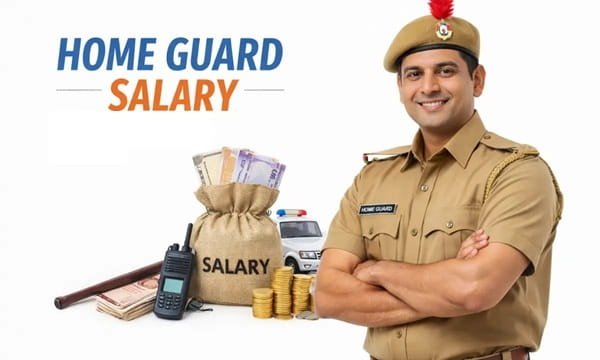
Home Guard is a volunteer security force that works as an auxiliary support system for the State and Union Territory police. Home Guards are used for law-and-order duty, traffic control, election duty, disaster relief, emergency support, crowd management, festival duty and other public security work. They operate under the respective State or UT Home Department, not as a single central government cadre.
The most important point is that Home Guard salary is different from regular police salary. In most states, Home Guards do not get a fixed 7th Pay Commission pay scale like Constable, SI or ASI. They are generally paid a daily duty allowance, call-up allowance or honorarium for the number of days they are deployed. This is why the monthly in-hand amount can change from state to state and month to month.
Home Guard Salary 2026 Quick Overview
| Component | Details |
| Post Name | Home Guard |
| Department | State / UT Home Department |
| Job Type | Volunteer Auxiliary Security Force |
| Regular Pay Scale | Usually Not Like Regular Police Employees |
| Salary Type | Daily Duty Allowance / Honorarium |
| Approx. Daily Allowance | ₹450–₹1,100 Per Day, State-Wise |
| Approx. Monthly In-Hand | ₹13,500–₹33,000, Depending On Duty Days |
| Odisha 2026 Example | ₹650 Per Day Duty Call-Up Allowance |
| Main Allowances | Duty Allowance, Uniform Support, Risk/Travel Support If Applicable |
| Main Deductions | Usually Limited; May Include Welfare Or Local Recovery |
| Work Nature | Police Support, Traffic, Election Duty, Disaster Relief And Public Security |
Home Guard Pay Scale
Home Guard usually does not have a regular pay scale like police constable or other permanent government employees. A police constable may have a fixed basic pay, DA, HRA, TA, NPS and other benefits, but Home Guards are mostly paid according to duty days.
For example, Odisha increased the daily duty call-up allowance of Home Guards from ₹639 to ₹650, effective from January 1, 2026. This shows how Home Guard payment is usually revised as a daily allowance, not as a full monthly pay scale.
In Gujarat, the daily allowance issue also reached the High Court. In 2026, the Gujarat High Court directed the state government to raise Home Guard daily allowance from ₹450 to an amount matching the minimum pay range of police constables, which was discussed around ₹21,000–₹25,000 monthly.
So, candidates should always check the latest state notification before assuming the exact salary.
Home Guard Salary At One Place
The table below gives a practical estimate of Home Guard earnings based on different daily allowance levels.
| Salary Component | Low Allowance State | Medium Allowance State | Higher Allowance State |
| Daily Duty Allowance | ₹450–₹550 | ₹600–₹750 | ₹900–₹1,100 |
| 20 Duty Days Monthly | ₹9,000–₹11,000 | ₹12,000–₹15,000 | ₹18,000–₹22,000 |
| 25 Duty Days Monthly | ₹11,250–₹13,750 | ₹15,000–₹18,750 | ₹22,500–₹27,500 |
| 30 Duty Days Monthly | ₹13,500–₹16,500 | ₹18,000–₹22,500 | ₹27,000–₹33,000 |
| NPS Deduction | Usually Not Applicable | Usually Not Applicable | Usually Not Applicable |
| Approx. In-Hand Salary | ₹13,500–₹16,500 | ₹18,000–₹22,500 | ₹27,000–₹33,000 |
These figures are practical estimates. Actual payment depends on state rules, number of duty days, deployment type, training days, festival duty, election duty, traffic duty, uniform benefits and local deductions.
Home Guard In-Hand Salary
The in-hand salary of Home Guard is usually based on the number of days worked. If a Home Guard gets ₹650 per day and works for 30 days, the monthly amount will be around ₹19,500. If duty is given for only 20 days, the amount will be around ₹13,000.
In states where the allowance is higher, the monthly in-hand amount may reach ₹25,000–₹33,000 if full-month duty is given. In lower-paying states, it may remain around ₹13,500–₹18,000.
This is why Home Guard salary should not be compared directly with regular police constable salary. A Home Guard may wear uniform and perform police-support duty, but the service structure is usually different.
Home Guard Salary Structure All Components
Daily Duty Allowance
Daily duty allowance is the main earning component of Home Guard. It is paid for the number of days the person is called for duty. If there is no duty, payment may not be made for that period.
Training Allowance
Some states may provide training allowance during official training periods. The amount depends on state rules and the type of training.
Uniform Support
Home Guards may receive uniform, kit or dress-related support as per department rules. In some states, uniform may be provided directly. In others, allowance or reimbursement may be given.
Travel Or Field Support
For election duty, outstation duty, disaster duty or special deployment, travel-related support may be given if allowed by state rules. It is not fixed everywhere.
Medical Or Welfare Support
Some states provide limited welfare support, accident support, insurance cover or medical assistance. These benefits are state-specific and should be checked from the latest Home Guard department rules.
Deductions From Home Guard Salary
Home Guard salary usually has fewer deductions than regular government salary. Since most Home Guards are paid duty allowance or honorarium, regular deductions like NPS, CGHS and pension contribution are generally not applicable in the same way as permanent employees.
Possible deductions may include welfare fund, uniform recovery, insurance contribution, local recovery or absence-related deduction. In most cases, the in-hand amount remains close to the duty allowance earned.
Home Guard Job Profile
Home Guards support police and administration in different types of duties. Their work may include traffic management, crowd control, patrolling support, election duty, festival deployment, disaster relief, fire and emergency support, public safety duty and assistance during law-and-order situations.
They may also be deployed during floods, cyclones, accidents, public gatherings, VIP movement, examinations and emergency situations. The job needs discipline, physical fitness, alertness and public dealing ability.
Home Guard work can be demanding because duty may come during festivals, elections, night shifts, traffic pressure or emergency situations. It is a uniformed public service role, but the employment structure is usually not the same as regular police service.
Home Guard Salary After 5, 10 And 20 Years
| Service Stage | Approx. Monthly Earning |
| At Joining | ₹13,500–₹33,000 |
| After 5 Years | ₹16,000–₹36,000 |
| After 10 Years | ₹18,000–₹40,000 |
| After 15 Years | ₹20,000–₹45,000 |
| After 20 Years | Depends On State Rules And Regularisation Policy |
These are broad estimates. Actual growth depends on state allowance revision, duty days, policy changes, court orders, regularisation rules and department-level decisions.
Career Growth And Regularisation
Home Guard career growth is different from regular police service. In many states, Home Guards remain volunteers and continue to receive duty allowance. However, some states may give preference, age relaxation or marks benefit in police recruitment, depending on rules.
In some cases, long-serving Home Guards have approached courts for better allowance, service security or regularisation. Punjab and Haryana High Court, for example, directed Punjab to frame a policy for regularisation of long-serving Home Guards in a case where volunteers had worked continuously for many years.
Still, candidates should not assume automatic regular government service from Home Guard joining. Regularisation depends on state policy, court orders, service period and government decision.
FAQs
Q1. What Is The Salary Of Home Guard?
Home Guard salary is usually paid as daily duty allowance. The monthly earning may come around ₹13,500 to ₹33,000, depending on state allowance and number of duty days.
Q2. What Is The Daily Allowance Of Home Guard?
The daily allowance differs by state. In Odisha, Home Guard daily duty call-up allowance was increased to ₹650 from January 1, 2026. Other states may pay higher or lower amounts.
Q3. Is Home Guard A Permanent Government Job?
In most states, Home Guard is not treated like a regular permanent police job. It is usually a volunteer auxiliary force paid through duty allowance or honorarium.
Q4. Does Home Guard Get DA And HRA?
Usually no. Home Guards generally do not get DA and HRA like regular government employees. Some states may provide separate benefits or allowances as per local rules.
Q5. Does Home Guard Get Pension?
Normally, Home Guards do not get regular pension like permanent government employees. Welfare, insurance or retirement-related benefits depend on state rules.
Q6. Is Home Guard A Good Job?
Yes, Home Guard can be useful for candidates who want uniformed public service, police-support experience and government-related duty exposure. But candidates should understand that salary, service security and benefits are usually lower than regular police jobs.